Research group · College of Science, Mathematics, and Technology

Edge–Cloud Continuum Research Group

Trustworthy, efficient, and intelligent orchestration of computing tasks and AI services in the edge–cloud continuum.

Led by Dr. Hamza Djigal

IF 50.6
IEEE Communications Surveys & Tutorials survey (2022), our most cited paper
20+
papers as first or corresponding author
6
papers with WKU students since 2024
3
CCF-C papers accepted in 2026 with students
CCF-A
IPPTS in IEEE TPDS (2021)

Who we are

We design scheduling and orchestration methods for workflows, AI models, and services that run across devices, edge servers, and clouds. Our work combines algorithms, machine learning, and real measurements on our own GPU and Jetson lab. Undergraduate, master, and PhD students are welcome: every new member starts with a clear first task and a path to a first paper.

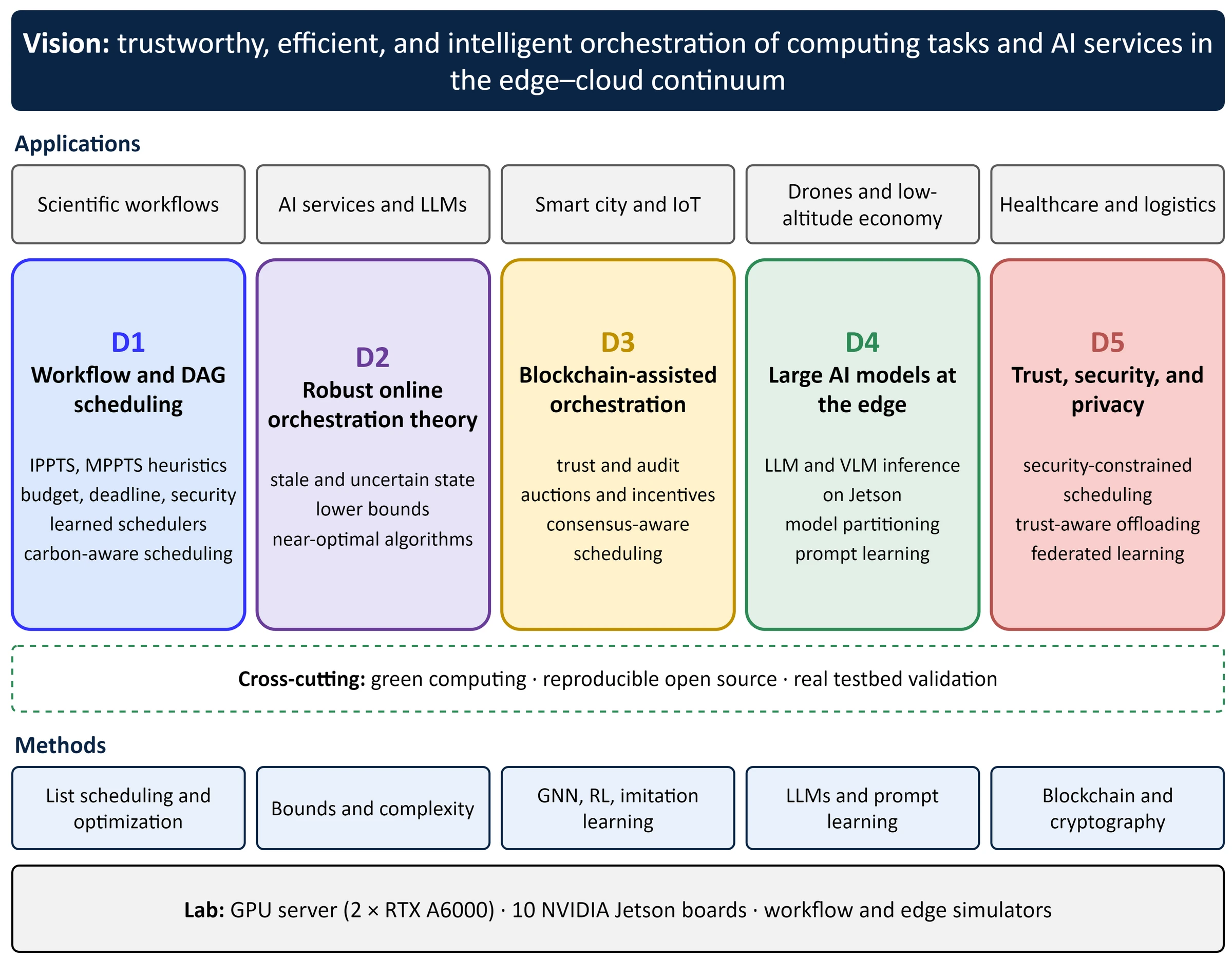
Research framework of the group
Research framework: five directions around one goal. Click the figure to open it full size.

Research directions

Each direction lists why it matters, what we have done, and what is still open.

D1

Workflow and DAG scheduling

Why it matters

Scientific, AI, and data pipelines are DAGs. Good scheduling saves time, money, and energy in clouds.

Our work

PPTS (ICPP-W 2019), IPPTS (IEEE TPDS 2021), MPPTS and BUCAS (ICA3PP 2025), SCMD (ICA3PP 2026), Look Before Scheduling (ACML 2026), Q-learning list scheduling (ICCC 2024)

Open problems

  • dynamic arrivals and online decisions
  • budget, deadline, and carbon objectives together
  • learned schedulers that generalize to unseen workflows

Skills that help

Python, algorithms, basic machine learning
6 open topics in D1
D2

Robust online orchestration theory

Why it matters

Real systems decide with stale and noisy information. We want to know how much this costs and how to do better.

Our work

DORA project on orchestration with stale state (under preparation)

Open problems

  • lower bounds for scheduling with delayed state
  • staleness-aware priority rules
  • measured staleness in real edge clusters

Skills that help

mathematics, probability, algorithms; simulation

3 open topics in D2
D3

Blockchain-assisted orchestration

Why it matters

When many providers share resources, blockchain gives trust, audit, and payment without a central party.

Our work

Survey: Blockchain-Assisted Task Orchestration in the Edge–Cloud Continuum (in preparation)

Open problems

  • consensus latency as a scheduling parameter
  • energy of consensus inside the objective
  • reproducible blockchain and edge testbeds
  • auction and incentive mechanisms

Skills that help

Python or Go, smart contracts (Solidity), networking

4 open topics in D3
D4

Large AI models at the edge

Why it matters

LLMs and VLMs must run close to users and devices with limited power. This is a national AI+ priority.

Our work

Prompt learning (ACM CSUR 2025, Neurocomputing 2025, 2026), GAPrompt (KBS 2025), ByteBridge (PRICAI 2026), lab with 10 Jetson boards

Open problems

  • profiling LLM/VLM inference on Jetson
  • partitioning models between device, edge, and cloud
  • scheduling LLM requests and AI-agent workflows

Skills that help

Python, PyTorch, Linux, interest in LLMs

5 open topics in D4
D5

Trust, security, and privacy

Why it matters

Edge nodes can be faulty or malicious, and user data are sensitive. Scheduling must stay safe.

Our work

SCMD security-constrained scheduling (ICA3PP 2026), fast adaptive momentum federated learning (CSAI 2024), trust-aware resource allocation (proposal submitted)

Open problems

  • security-constrained online scheduling
  • trust-aware offloading with cheap verification
  • federated learning on real edge devices

Skills that help

Python, security basics, machine learning

3 open topics in D5

Lab and facilities

GPU server

2 NVIDIA RTX A6000 GPUs (96 GB GPU memory in total), Intel Core i9-14900K, 64 GB RAM. Used for training graph schedulers, language models, and large simulations.

Edge cluster of 10 NVIDIA Jetson boards

AGX Orin 64GB (1), Orin NX 8GB Super (3), Orin Nano Super (3), Xavier NX (1), and Nano (2). Used for real measurements of AI inference, power, and state staleness at the edge.

Shared tools

Group Git repository, shared paper table, lab booking sheet for the GPU server and the boards, and a group tracker for topics and papers.

Projects

Research on Reinforcement Learning-Based Offloading and Scheduling Mechanisms in Multi-access Edge Computing

National Foreign Expert Project, Ministry of Science and Technology of China (QN2022014001), RMB 200,000, PI

Completed

Research on Intelligent Resource Allocation Mechanisms for Internet of Medical Things in Multi-access Edge Computing

WKU Internal Start-Up Research Grant (ISRG2023024), 2024 to 2026, PI

Ongoing

Security-Sensitive Resource Allocation Mechanisms for IoT in MEC

WKU Student Partnering with Faculty (SpF), 2024 to 2025, PI

Completed

NSFC Research Fund for International Scientists (2025 and 2026)

National Natural Science Foundation of China, PI

Submitted

Zhejiang Provincial Natural Science Foundation (2026)

PI

Submitted

CarbonFlow: carbon-aware dynamic workflow scheduling

WKU Student Partnering with Faculty (SpF) 2027, PI

Submitted

Papers with our students

6 papers written with WKU students. All publications

2026

Look Before Scheduling: A Low-Cost Supervised Graph Scheduler for Dynamic Workflows

Xue, Q., Hamza Djigal, Zhang, C.

Asian Conference on Machine Learning (ACML), Proceedings of Machine Learning Research, vol. 353, 2026

CCF C Accepted
2026

SCMD: Security-Constrained Multi-Predecessor Duplication Algorithm for Scientific Workflow Scheduling in IaaS Clouds

Zhang, C., Xue, Q., Hamza Djigal

International Conference on Algorithms and Architectures for Parallel Processing (ICA3PP), Springer LNCS, 2026

CCF C Accepted
2026

ByteBridge: Diagnosing the Limits of Byte Input Adapters for Frozen Tokenizer-Based Language Models

Zhang, C., Xue, Q., Hamza Djigal

Pacific Rim International Conference on Artificial Intelligence (PRICAI), Springer LNAI, 2026

CCF C Accepted
2025

MPPTS: Multi-Factor Predictive Priority Task Scheduling Algorithm for Heterogeneous Systems

Jiao, L., Hamza Djigal, Ba, A.F., Muhammad, A.U.

ICA3PP 2025 — Springer LNCS, pp. 393-412, 2025

2025

BUCAS: Budget Constrained Application Scheduling in IaaS Clouds

Ni, X., Hamza Djigal, Ba, A.F., Muhammad, A.U.

ICA3PP 2025 — Springer LNCS, pp. 367-379, 2025

2024

Performance Evaluation of Q-Learning-Based List Scheduling Algorithms in Heterogeneous Systems

Q. Xue, Hamza Djigal, M. Cheraghy

2024 IEEE International Conference on Computer and Communications (ICCC), pp. 343-350, 2024

Join us: open topics

Each topic builds on our published work, so you start from working code and a clear target. UG = undergraduate (capstone or SpF), MS = master, PhD = doctoral. Levels are a guide, not a limit.

T1 D1 UG

Benchmark of list-scheduling and learned schedulers on WfCommons workflows

Builds on:
HEFT, PEFT, IPPTS, ACML 2026 code
Target:
benchmark paper (Level 1–2)
T2 D1 UG

CarbonFlow: carbon-aware dynamic workflow scheduling

Builds on:
ACML 2026 code; CarbonFlow project (submitted)
Target:
ICA3PP or FGCS
T3 D1 UG/MS

Budget- and deadline-constrained dynamic scheduling with supervised graph policies

Builds on:
BUCAS + ACML 2026
Target:
CCF-C conference
T4 D1 MS

Scheduling LLM-agent workflows (tool-call DAGs) in the cloud

Builds on:
IPPTS, MPPTS
Target:
CCF-C conference or JPDC
T5 D1 MS

Why learned schedulers fail on unseen workflow families, and how to fix it

Builds on:
ACML 2026 limitations
Target:
CCF-C or SCI journal
T6 D2 UG

Measuring state staleness on our Jetson edge cluster

Builds on:
DORA project (under preparation)
Target:
measurement paper (Level 1–2)
T7 D2 MS

Staleness-discounted HEFT: priority rules for stale state

Builds on:
DORA project, HEFT
Target:
CCF-C conference
T8 D2 PhD

Lower bounds for two-processor scheduling with delayed state

Builds on:
DORA project (under preparation)
Target:
SCI journal or theory venue
T9 D3 MS

Consensus-finality-aware task scheduling

Builds on:
blockchain survey, challenge 'latency'
Target:
CCF-C conference
T10 D3 UG/MS

Auction-based incentive scheduling with smart contracts

Builds on:
blockchain survey, 'decision mechanisms'
Target:
CCF-C conference
T11 D3 UG

A containerized blockchain and edge testbed for reproducible evaluation

Builds on:
blockchain survey, 'evaluation realism'
Target:
tool or benchmark paper
T12 D3 MS

Green blockchain scheduling: consensus energy in the objective

Builds on:
blockchain survey, 'energy'
Target:
IEEE TSUSC or FGCS
T13 D4 UG

Profiling LLM and VLM inference on Jetson boards

Builds on:
lab Jetson boards
Target:
measurement or dataset paper
T14 D4 MS

Partitioning LLM inference between a Jetson board and a GPU server

Builds on:
Neurosurgeon-style model split
Target:
CCF-C or IEEE IoT-J
T15 D4 MS

Request scheduling for LLM serving on edge devices

Builds on:
list scheduling + LLM serving systems
Target:
CCF-C conference
T16 D4 MS

Prompt compression for edge language models

Builds on:
GAPrompt (KBS 2025), KHSPrompt
Target:
Neurocomputing or KBS
T17 D4 MS

Byte-level input adapters for frozen language models: extensions

Builds on:
ByteBridge (PRICAI 2026)
Target:
CCF-C conference
T18 D5 UG/MS

Security-constrained dynamic workflow scheduling (online SCMD)

Builds on:
SCMD (ICA3PP 2026)
Target:
CCF-C or SCI journal
T19 D5 MS

Trust-aware offloading with lightweight result verification

Builds on:
Freivalds check, reputation models
Target:
CCF-C conference
T20 D5 UG/MS

Federated learning on real Jetson boards with adaptive momentum

Builds on:
fast adaptive momentum FL (CSAI 2024)
Target:
CCF-C conference
T21 D1 UG

From Q-learning to deep RL list scheduling: a fair comparison

Builds on:
ICCC 2024 paper
Target:
EI conference
T22 All directions MS

Mini-survey: large language models for resource scheduling

Builds on:
our two surveys as models
Target:
survey journal (e.g., IEEE Access)

How to join

  1. 1Fill in the short form: name, ID, major, year, skills, preferred directions (first and second choice).
  2. 2Read the guide and two papers of your preferred direction.
  3. 3Meet the PI (15 minutes) to choose a starter topic.
  4. 4Get access to the Git repository, the paper table, and the lab booking sheet.
  5. 5Start with Level 1: reproduce one baseline in your first two months.

Interested?

Write a short email with your name, student ID, major, year, skills, and your first and second choice of direction or topic. We reply with a time for a 15-minute meeting.

Email dhamza@kean.edu

Life in the group

  • Weekly report: every Friday: what I did, what I found, what blocks me, next step (one page)
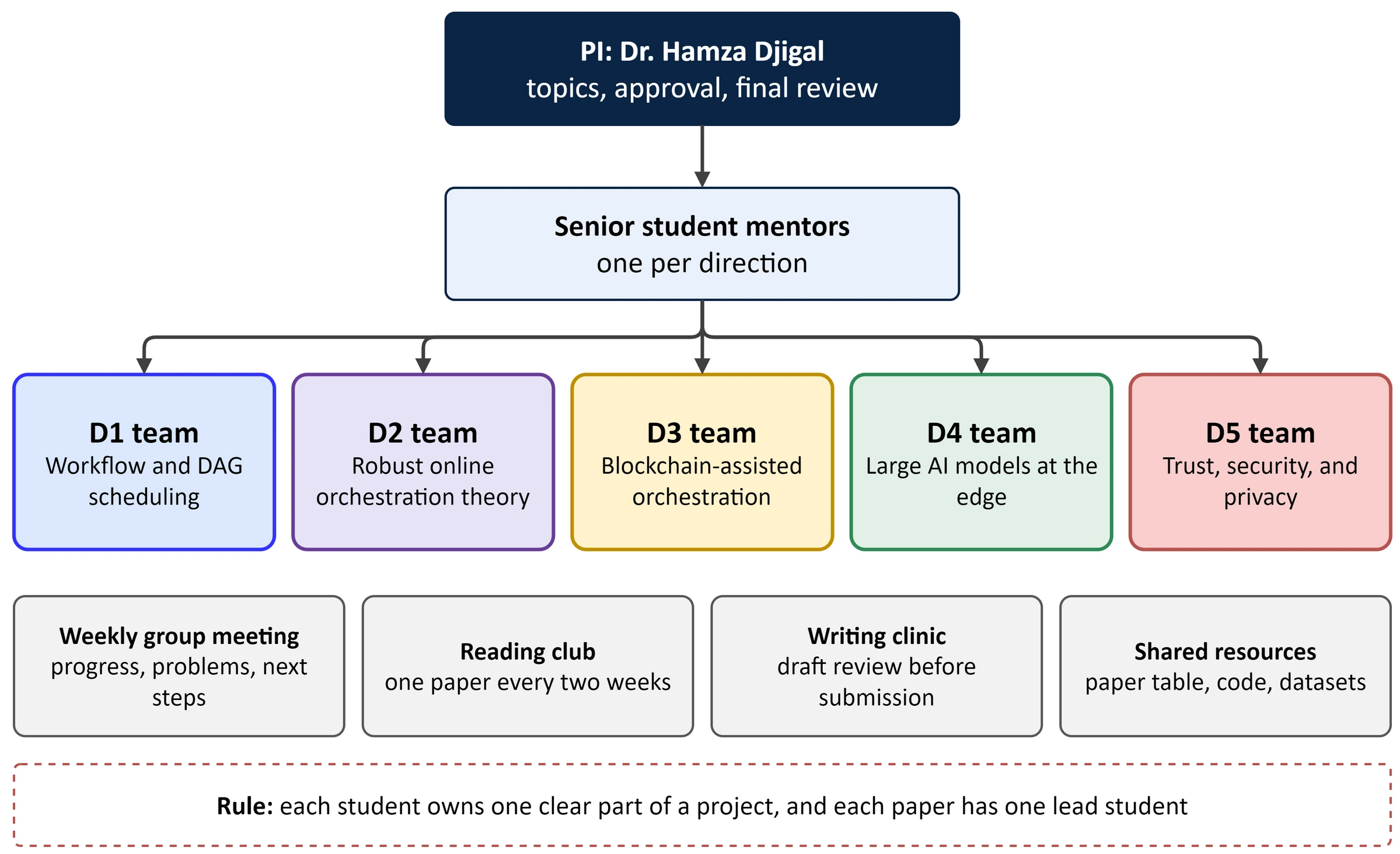
  • Group meeting: every week, 60 minutes: 2–3 students present, others ask questions
  • Reading club: every two weeks: one student presents one important paper
  • Writing clinic: before each submission: the group reviews the draft
  • Monthly talk: each student gives a 10-minute talk with figures and numbers
How the group is organized
How the group is organized: the PI, one senior student mentor per direction, the five teams, and the shared activities.

Student resources

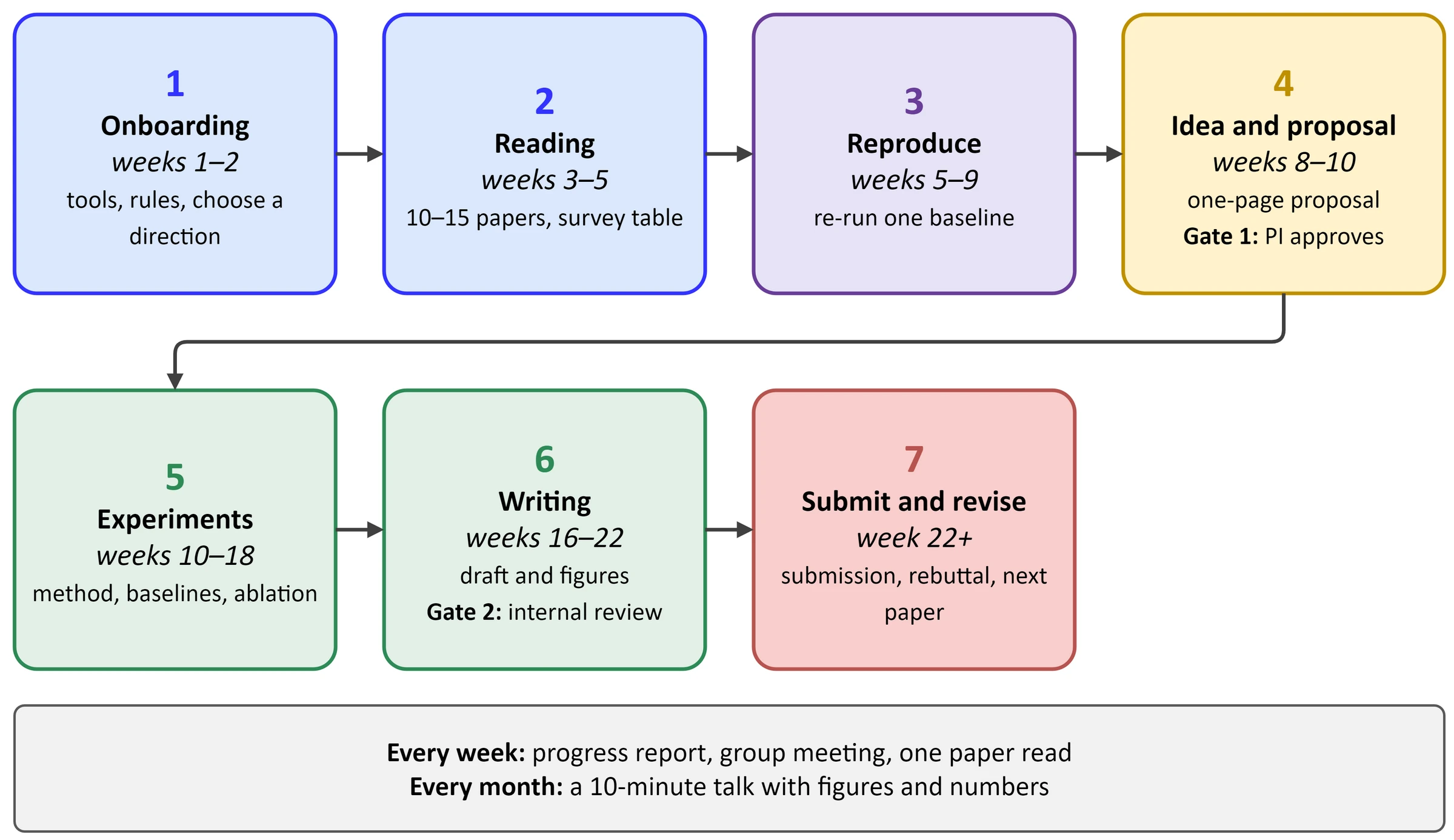
From the first idea to the first paper: how we work, and what we expect.

Student journey in the group
Student journey: seven steps from onboarding to submission, with two review gates.

How to get a research idea

  1. 1Read 10–15 recent papers in your direction (last 3 years, good venues) and fill the shared paper table: problem, assumptions, method, data, baselines, results, limitations.
  2. 2Mark the assumptions that are not realistic. Look at the limitations and future-work sections.
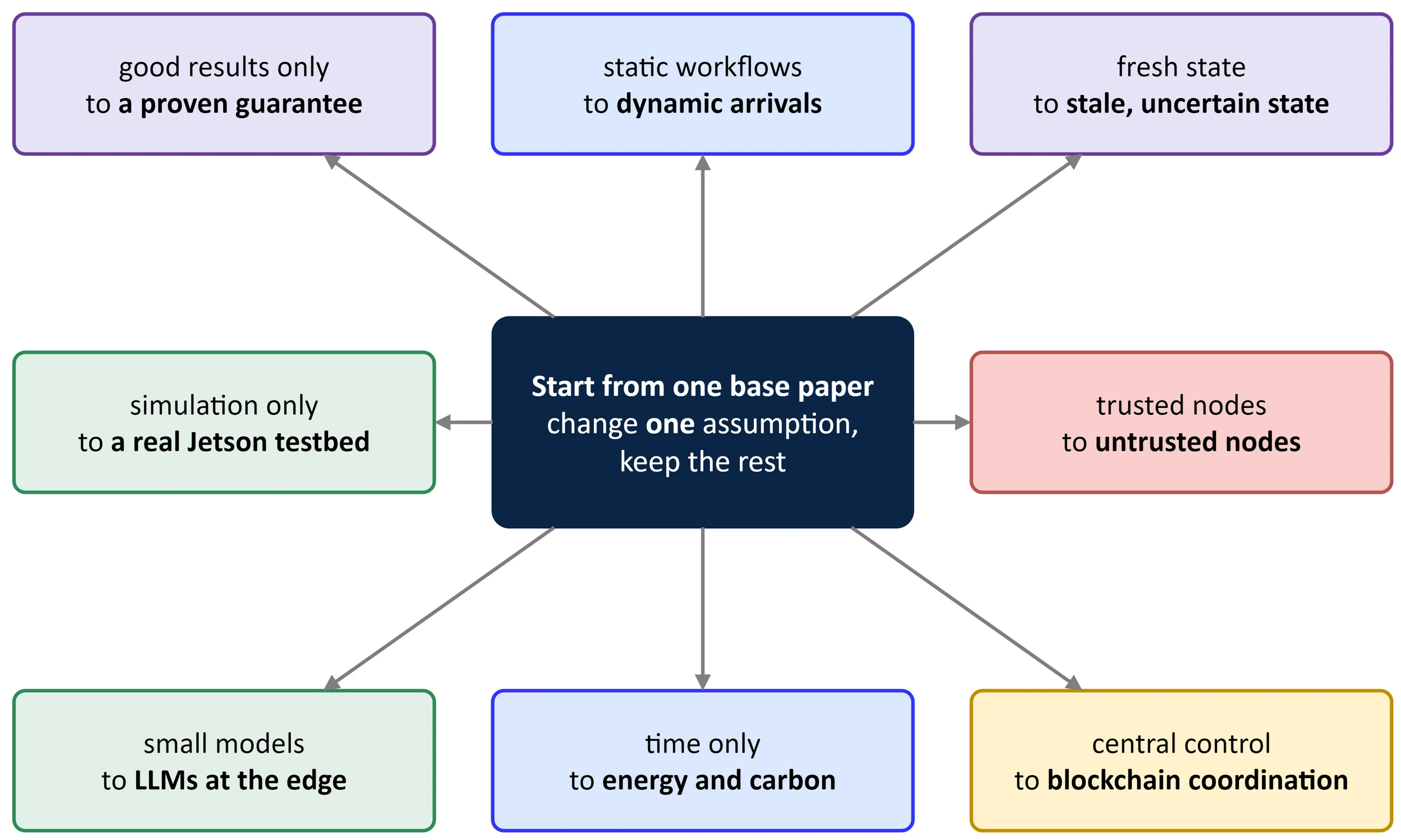
  3. 3Change one assumption and keep the rest (see the idea wheel). Ask: does the old method fail now? Why?
  4. 4Check novelty: search Google Scholar, IEEE Xplore, and arXiv for 30 minutes with 3–4 keyword sets. If someone did it, change the angle or the assumption.
  5. 5Check feasibility: can you get data, code, and results in 3–4 months with our lab?
  6. 6Write the one-page proposal and discuss it with the PI.
Idea wheel
The idea wheel: change one assumption of a known problem and keep the rest.

Six quick ways to a first paper

Type 1

Reproduce and compare

Re-run 4–6 known algorithms on the same open workflows and report honest results. Every new student can do this in 2–3 months (T1, T21).

Type 2

Measure the real system

Measure LLM inference, power, or state staleness on our Jetson boards. Real data are rare and reviewers like them (T6, T13).

Type 3

Add one objective

Take one of our algorithms and add carbon, cost, or security to it (T2, T3, T18).

Type 4

Fix a stated limitation

Every paper lists its limitations. Our ACML paper lists three. Each one is a new paper (T5).

Type 5

Move to a new workload

Apply a known scheduler to LLM-agent workflows or blockchain transactions (T4, T9).

Type 6

Turn a survey challenge into a method

Our blockchain survey has a table of seven open challenges. Each row is a topic (T9–T12).

The one-page proposal

Before any experiment, write one page with these eight parts and discuss it with the PI.

Titleshort and precise (method + problem + setting)
Problem2–3 sentences: what is the problem, and why does it matter?
Gapwhat existing work does not do (cite 3–5 papers)
Ideayour main idea in 3 sentences, and why it should work
Methodmodel, algorithm, or system; what you will build
Evaluationdata, baselines, metrics, expected result
Plantasks per month and the target venue with its deadline
Riskswhat may fail, and plan B

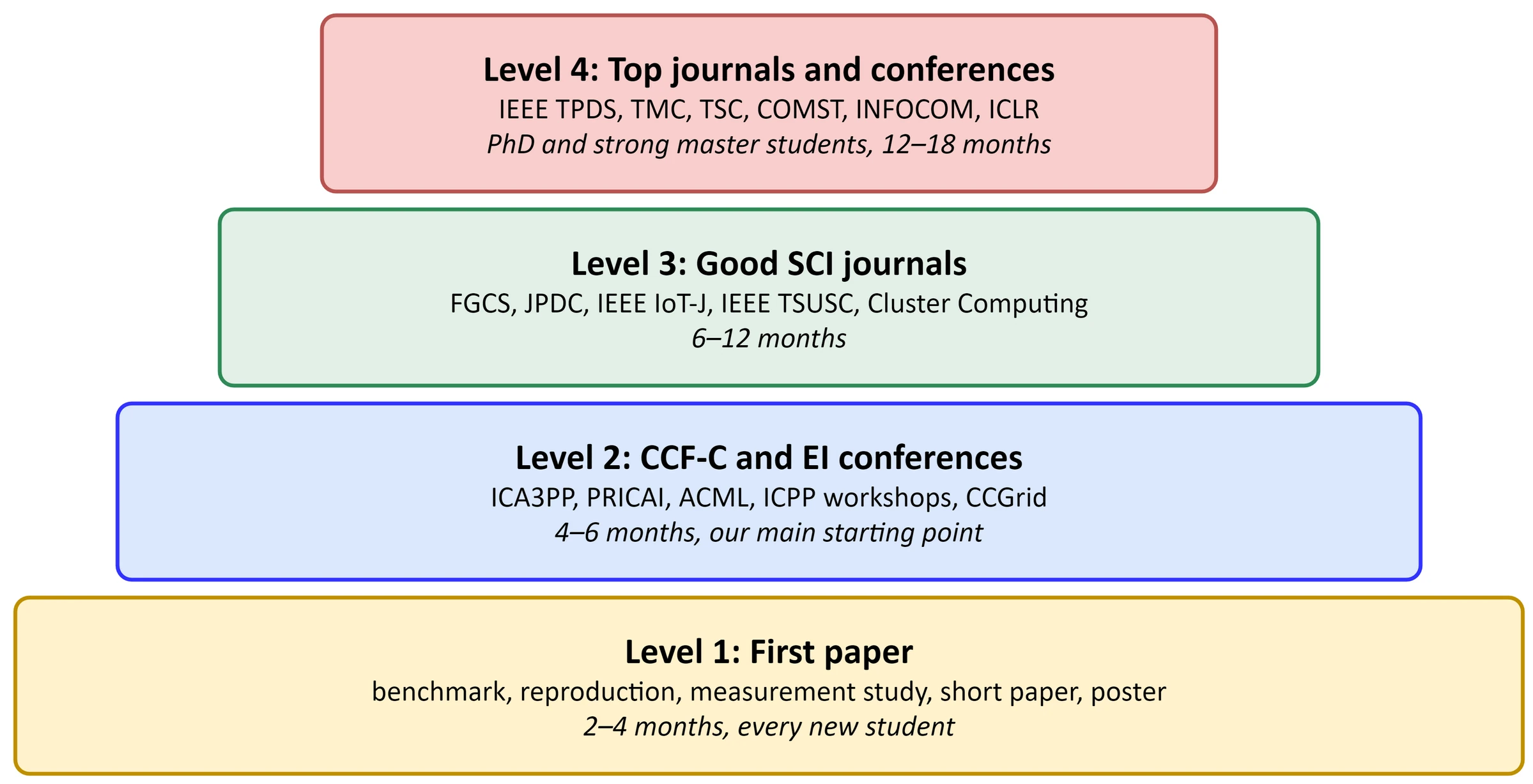
The publication ladder

Publication ladder
The publication ladder: from a first benchmark or reproduction paper to top journals and conferences.

Writing guidelines

  • Structure: Abstract, Introduction (problem, gap, contributions as (1), (2), (3)), Related work, System model and problem, Method, Experiments, Conclusion.
  • Write the contributions list first. Every section must support one contribution.
  • Make the figures and tables first; then write the text around them.
  • One idea per paragraph. Short and clear sentences. Define every symbol once.
  • Use plain academic English with simple connectors: Also, Moreover, However, Therefore, Hence, For instance.
  • Avoid AI-style writing: no em dashes, no arrows in text, no slogans, no empty words such as 'paradigm shift' or 'seamlessly'.
  • Every claim needs a number, a reference, or a proof. Never invent references; check each one online.
  • Compare with strong and recent baselines, use several random seeds, and report the mean and standard deviation.
  • Before submission: internal review by one group member, grammar check, reference check, and the venue template.

Use of AI tools

  • Allowed: grammar checking, code debugging, literature search help, and translation, if you check the result yourself.
  • Not allowed: text or results generated without your own verification, invented references, or AI-written reviews.
  • Always tell the PI where you used AI tools. Follow the policy of the target venue.
  • You are responsible for every word, number, and reference in your paper.

Group rules

  • Research integrity first: no fabrication, no plagiarism, no duplicate submission.
  • Wenzhou-Kean University is the first affiliation. Acknowledge the funding project and its number.
  • Authorship: the student who leads the work is the first author; the PI is the corresponding author; others who contributed are co-authors. Agree on the author list before writing.
  • Code and data go into the group Git repository. Experiments must be reproducible.
  • Report problems early. A blocked week is fine; a silent month is not.
  • Respect the lab equipment and the booking sheet for the GPU server and the Jetson boards.